
There are still some voices of reason
Two days ago, we recalled Helmut Schmidt’s saying, "Better to negotiate for 1,000 hours than to wage war for one hour", when we had to report on the commander-in-chief of the German Air Force, who said he was ready to fight against Russia "as early as tonight." So—even though we see a great danger in his statement — we can say that there are other assessments of the (military) situation.
For example, Telepolis features an interview with former Bundeswehr Colonel Wolfgang Richter, who explains why Europe’s military is clearly superior to Russia’s in conventional terms. Therefore, it would be completely illogical — both militarily and economically — from Russia’s perspective to start a war against a NATO country. This remains true even if the massive military support provided by NATO countries to Ukraine provokes Russia to the utmost. This support—in the form of weapons deliveries, logistics, and target identification deep within Russia’s rear — has been operating for years on the very edge of what is permitted under international law, so as not to become a party to the war. We recall the unspeakable Taurus debate.
A comparison of the two sides’ military capabilities is provided on the website www.rnd.de/politik/nato-gegen-russland from January 26, which unfortunately can no longer be found at the link provided. But it is precisely this imbalance in favor of the NATO states that Wolfgang Richter, a retired colonel and former security expert at the German Institute for International and Security Affairs (SWP) — and, according to Telepolis.de, currently an associate fellow at the Geneva Center for Security Policy (GCSP) — also points out. He considers many of the threat scenarios currently circulating to be exaggerated.
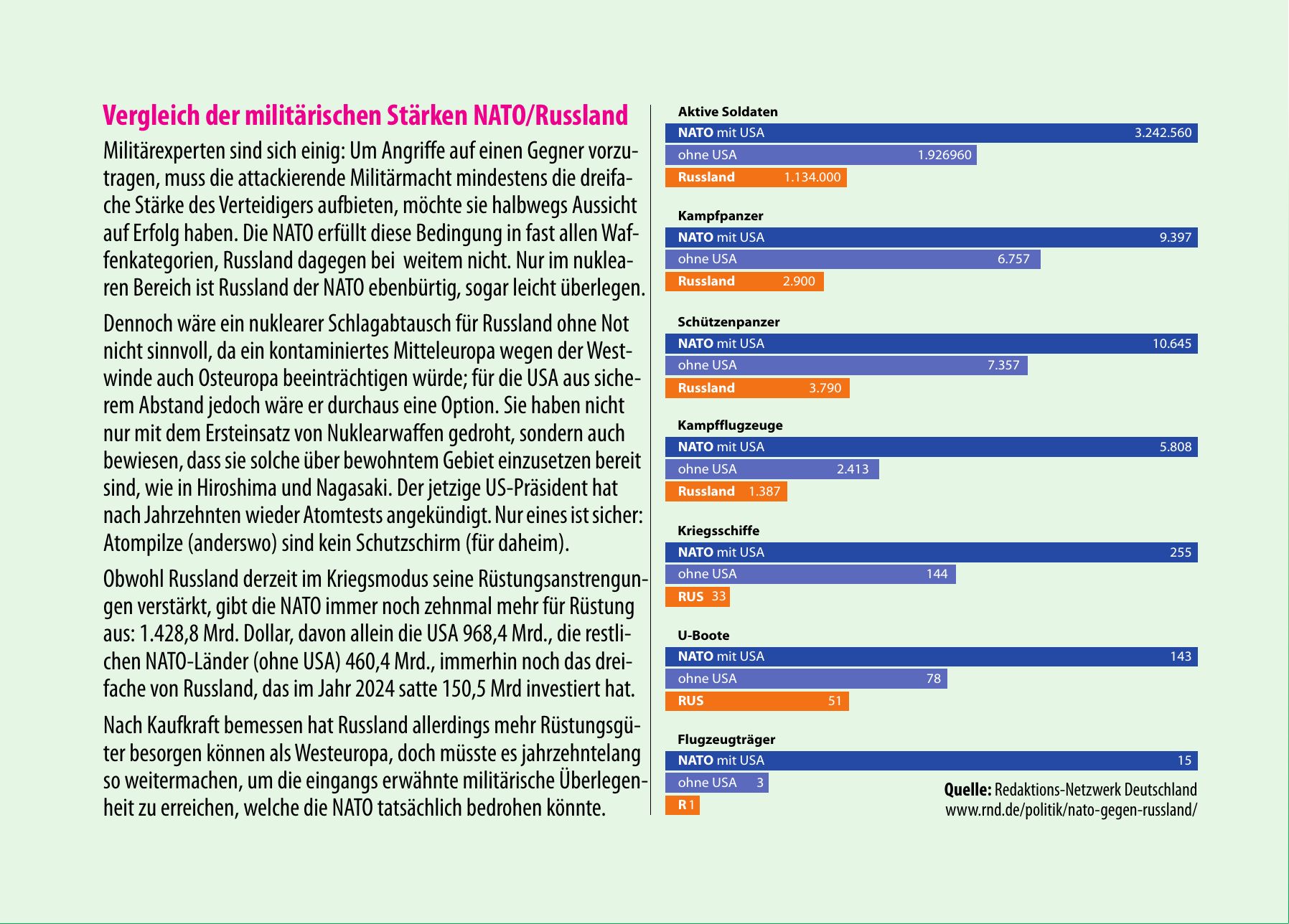
Russia’s only "trump card" would be its nuclear missiles, the use of which must be avoided for reasons of common sense — unless one wishes to destroy humanity. Knowing this, the West reacts calmly to threats from Russia in this regard. However, it is time to return to a policy of negotiation, arms control, and disarmament. With this policy, the West also made significant economic progress in the 1980s and early 1990s.
The fact that his assessment is not an isolated opinion is demonstrated by similar calls from, for example,
- Dr. Michael von der Schulenburg (diplomat, former Assistant Secretary-General to the UN Secretary-General), here is a link to his speech in Berlin https://www.a-fsa.de/d/3xE
- Prof. Dr. Gabriele Krone-Schmalz (author, journalist), here is the link to her speech in Berlin https://www.a-fsa.de/d/3xz
- Dr. Sahra Wagenknecht (BSW), here is the link to her speech in Berlin https://www.a-fsa.de/d/3xC
In any case, Wolfgang Richter’s arguments are important and worth reading, just like those of the people just mentioned. In the public debate, however, the only calls being made are for military readiness and, more recently, for more shelters and bunkers. Through rearmament and, in particular, the construction of bunkers, a certain Enver Hoxha already plunged his homeland into decline, as the author was able to observe there three months ago ...
Category[21]: Unsere Themen in der Presse Short-Link to this page: a-fsa.de/e/3Qn
Link to this page: https://www.a-fsa.de/de/articles/9571-20260623-zum-kraefteverhaeltnis-russland-nato.htm
Link with Tor: http://a6pdp5vmmw4zm5tifrc3qo2pyz7mvnk4zzimpesnckvzinubzmioddad.onion/de/articles/9571-20260623-zum-kraefteverhaeltnis-russland-nato.htm
Tags: #Kräfteverhältnis #Vergleich #Russland #NATO #Atomwaffen #Militär #Bundeswehr #Aufrüstung #Waffenexporte #Drohnen #Frieden #Krieg #Friedenserziehung #Menschenrechte #Zivilklauseln
Created: 2026-06-23 08:17:00
Kommentar abgeben